

Lucky Scooters FAQs
Lucky Sponsorship Questions
Product Questions
Online Site Questions
Complete Comparison
Sponsorship Information
A."We're always on the lookout for the best riders out there to expand the sport, ride our products and wear our gear. Start by sending an email and great edit! to marketing@luckyscooters.com. Please don't send us a video file. Upload your edit to Youtube or other video site and send us the link to watch it. If we are interested we will reply to you. We welcome Title team applications for sponsorship. Pro and International membership are by invitation only.
A. You don't need to be riding Lucky parts in your sponsorship edit. We mostly look for style and flare and someone who can represent Lucky in a positive way. Show us your best stuff!
A. A typical sponsorship video is between 2 and 4 minutes, although if you feel you need more time to show us your skills that’s perfectly fine!
A. There are no set tricks that need to be landed to get sponsored. We mostly look for style and flare and someone who can represent the Lucky brand positively.
Product Questions
Q. Do scooters come assembled or in parts?
A. All of our complete scooters come partially assembled (including custom scooters). For shipping purposes the bar is not attached. When it arrives all you have to do is attach the bar, tighten the bolts and then go ride! Please note: Tools provided in our complete scooters are intended to be used for bar installation, headset adjustment and brake removal/replacement. Additional tools may necessary to remove wheels and or axles.
Q. How long will my custom bars take to process?
A. There are many variables when you place a custom bar order with Lucky. Most orders ship in 24 - 48 hrs. Our shipping department ships Monday - Friday.
*Custom Sized Bar orders are final once the order button has been clicked. Cancellations are done at Lucky Scooters discretion and a partial refund may or may not be given for your order.
Q. How often do you come out with new models of old products or completely new products?
A. We try to stay on the cutting edge of scooter design. Our designers are always working on something new, although there is no set release date each year for new products. Once something has been run through research and development, we will make it available to the public. Our Facebook page is a great way to see what we are working on or what might be coming out soon!
Q. Can I get a copy of the Lucky Rider Manuals and see some product videos?
A. You can get a copy of your Lucky Scooters rider manual here Download Link.
Q. Glossary of Scooter Terms
|
Glossary Terms
|
|
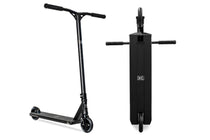
| Deck | The Base of the scooter in which all parts attach |
| Headtube | Attached to the base, it holds the headset bars and fork. |
| Headset | Is the set of components on a scooter that provides a rotatable interface between the fork and the head tube. The two types headsets are threaded and threadless. |
| Fork | Component that is inserted into the headset and used to mount the bars and also the front wheel. |
| Threaded Fork | Term referring to a type of fork or headset in which a large diameter nut threads on the top tube of fork compressing the headset components to enable proper rotation of the fork in the headset. |
| Threadless Fork | Term referring to a type of fork or headset in which a compression system (ICS, HIC) is need to compress the headset components to enable proper rotation of the fork in the headset. |
| Starnut | A flanged spring steel nut that seats in the fork or bars allowing the connection of a compression system. |
| HIC | Hidden Internal Compression. a shim that is slipped over the top of the fork, a bolt is inserted into the top of the shim, the bolt threads into the starnut contained inside the top tube of the fork, the bolt is tightened to compress the headset components allowing fork rotation. |
| ICS | Inverted Compression System. Uses a 200mm bolt insetered into the base of the fork tube, the bolt then threads into a starnut contained in the base of a standard diameter bar (1 ¼’) enabling proper rotation of the headset components. |
| SCS | Standard Compression System. A one piece bar clamp and compression system, an elongated clamp is slipped over the top tube of the fork, a top cap and bolt is then inserted into the top of the clamp, the bolt threads into the starnut contained inside the top tube of the fork, allowing fork rotation. |
| Bars | Chromoly tubes in various lengths and widths welded together to create a stylish control device used for steering, spinning and lifting the scooter. |
| Oversized Bar | Common name for a bar with a 1 3/8” down tube, the cross bar is 7/8” |
| Standard Bar | Common name for a bar with a 1 1/4’ down tube, the cross bar is 7/8”. |
| Clamp | Available in standard and oversize, used on the base of the bars after installing onto the fork the clamp uses bolts to pinch the bars and put pressure on the fork, allowing proper steering control. |
| Grips | Various shaped rubber material applied onto the end of the cross bar to provide style, control while reducing vibration and hand fatigue. |
| Bar Wrap | A printed or colored sticky back vinyl product,that is cut and applied to bars allowing a custom look for the scooter. |
| Wheel | A core surrounded by urethane, common sizes are 100mm and 110mm diameter; durometer ranges from A30 (soft) to D100 (hard), rebound is also important, more rebound carries more energy and is faster but you lose traction. |
| Wheel Bearings | Two bearings that are pressed into the wheels core, one on each side with a spacer in between, the spacer prevents the bearings from being pushed into the wheel core upsetting the proper alignment of the bearings and axle. |
| ABEC | There are five classes from largest to smallest tolerances: 1, 3, 5, 7, and 9, the higher the number the greater the speed capabilities, The ABEC rating does not specify other critical factors, such as smoothness, ball precision or quality/type of steel used. most common are the abec 5 |
| Brake | A foot controlled device bolted to the back of the deck used to control and stop the scooter. |
| Brake Spring | A small spring installed with a spring type brake that allows the brake to return to its operating position after application. |
| Axle | Machined hardware used to install the rear wheel into the deck and the front wheel into the fork. |
| Pegs | Attached to the fork and rear of the deck with longer axles, used to grind and stall on various objects. |
| Deck Spacers | Installed on each side of the rear wheel, deck spacers are designed to center the rear wheel in the deck. |
| Grip Tape | An abrasive material with an adhesive on the back designed to be installed on the top surface of the deck to give a rider maximum foot control. |
| Complete | Fully built and fully assembled scooter. |
| Graphics | Design’s that make the scooter stand out. |
| Wheelbase | Distance in between the front and rear wheels. |
| Hardware | Miscellaneous pieces used to fasten or affix the scooter. |
Q. How do I install my Lucky Scooter grips?
A. We get a lot of emails regarding instructions on how to install scooter grips, following the simple instructions below should help you get a grip on things.
- Clean bar with thoroughly! Don't leave handlebars soapy or wet.
- Apply a squirt of hairspray or hand sanitizer inside the grip. (we recommend this method if an air compressor is not available)
- Get the excess hairspray out by flinging the grip while still in your hand.
- Push or pull the new grip onto the bar. Use more hairspray if necessary. Don't stop pushing until the grip is all the way on.
- Make sure they are where you want them because when the hair spray or sanitizer dries, they will not move.
- Let dry for at least a couple of hours. Please Note: It could take at least 24 hour for liquid to completely dry (riding with grips that are not secure can be dangerous)
Q.How wide should I order my bars?
A. Most riders recommend that the width of your bars should be about the same as the width of your shoulders. this will improve your comfort level and improve your grip on the bars, resulting in longer sessions.
Q. If I need SCS, How should I order my bars?
A. The SCS accounts for 2" inches of total bar height, so if the rider needs 24" bar height, order 22" bars. Please note we modify bars based on bar height and not ride height.
Q. What are your parts made out of?
A. The majority of our parts are made from 6061 Aircraft Grade Aluminum or 4130 Chromoly Steel. High quality materials result in strong light products. We back our products with an industry leading 180 day warranty against manufacturer defects.
Q. What do I need to keep my Lucky Scooter maintained? (general maintenance)
A. Lucky Pro Rider Blake Bailor can help you out. He does the following:
- Make sure that your compression system is tight.
- Always tighten axle bolts before you ride.
- Keep your grip tape clean.
- Make sure the bar clamp is tight.
- Keep headset and wheel bearings lubricated and dirt free.
- Replace any worn bolts at the first sign of wear.
- Replace worn or torn grips for your safety, as well as others you ride with.
Q. What is the headtube angle on most Lucky decks?
A. The headtube angle on most completes is 82.5 degrees.
Q. Which axle do I need for the Lucky Pegs?
A. All of our pegs sets come with a spacers and axles in a variety of lengths. This allows our pegs to fit on almost any scooter in a variety of configurations.
Click Here to go back to the top.
Online, order and shipping questions
Q. Can I check my order status?
A. Use this link to see your order status online. Make sure you have your order number and email address used to place the order.
Q. Is Emailing or calling customer service better?
A. Every weekday morning we check our email and voice mail. It is completely up to you if you want to call or email, response time will be about the same. You can also always hit us up on our website or on Our Facebook! Page
Q. How do I return or exchange my order?
A. If you have an order you wish to return or exchange please read our customer care information page here.
Q. What UPS services are guaranteed at this time?
A. The UPS® Service Guarantee is currently active for the below domestic and international services but otherwise remains suspended:
Domestic
- UPS Next Day Air®
- UPS Next Day Air Saver®
- UPS Next Day Air® Early
International
- UPS Worldwide Express Plus®
- UPS Worldwide Express®
- UPS Worldwide Express NA1®
- UPS Worldwide Express Saver®
- UPS Worldwide Saver®
- UPS Worldwide Express Freight® Midday
- UPS Worldwide Express Freight®
Until further notice, the guaranteed delivery time for UPS Next Day Air Saver® deliveries has been extended to end-of-day (11:59 p.m. on the guaranteed day of delivery).
The UPS Service Guarantee remains suspended for all other UPS® shipments and services not specified in the above sections, from any origin to any destination.
Q. Can you return custom or cut bars?
A. Bars that are cut for SCS compression systems are considered a custom sized bar. These bars will not be eligible for a return even if in new condition. Contact customer service if you have any further questions.
Q. My item was damaged in shipping what do I do?
A. If you receive a damaged item in your order, please send an email to customer service (info@luckyscooters.com) or fill out this form. You will receive a reply within 24 hours, Monday through Friday.
Q. I did not see any security certificates at check out. How is your site protected?
A. We have a Thawte SSL certificate and the cart only allows checkout in HTTPS mode.
|
|
|
|
|
|
|
Scroll right to see all scooters
|
|||||